
RC Lens history is inseparable from the coalfields of northern France, the workers who built their lives around the mines and a community that repeatedly helped its football club rise again. Ahead of the Champions League meeting between Como and Lens, The Como Football Journal retraces the transformation of Racing Club de Lens from a team founded by local students into one of the most distinctive institutions in French football. Lens may not possess the honours list of Paris Saint-Germain, Marseille, Lyon or Saint-Étienne, but few French clubs represent their city and territory with the same intensity. The red-and-gold shirt reflects a region shaped by war, industrial development, migration, the decline of coal mining and the constant need to rebuild.
RC Lens history: the birth of Racing Club Lensois
Football began to spread across northern France at the end of the 19th century. In Lens, school and university students regularly spent their weekends playing in the streets and courtyards of the city. In 1906, Jules Van de Weigh and Carlos Douterlungne founded Racing Club Lensois to give the young people of Lens a proper football team. Van de Weigh became its first president, while the café owned by Carlos’ brother Henri served as the club’s first headquarters. Émile Basly, the mayor of Lens, allowed the students to mark out a pitch on the Place Verte, now known as the Place de la République. Although the project began in 1906, the club’s first statutes were officially registered on 18 October 1907. Racing joined the Artois football committee and entered its first championship in 1910. The surrounding environment immediately influenced the club’s identity. Lens initially played in green, representing the Place Verte, and black, symbolising the coal mines at the heart of the local economy. The first team used a ground provided by the Compagnie des Mines de Lens before moving to the Parc de la Glissoire in nearby Avion in 1913.
War, reconstruction and migration
The First World War abruptly interrupted the club’s development. Lens and the surrounding territory suffered extensive destruction, leaving the population with the difficult task of rebuilding the city. Racing resumed its activities in 1919 with the support of Mr Laroche, director of the local branch of the American Committee for Devastated Regions. He provided a ground known as the pâture Tacquet, situated close to today’s Stade Léo Lagrange. In return, Racing joined the Union Sportive du Foyer Franco-Américain and adopted blue shirts, white shorts and red socks. Local businessman Fleury Pierron became president in 1921. Until then, the squad had consisted mainly of young players from Artois, but its composition changed with the arrival of Italian and Polish footballers who had moved to northern France to work in the mines. Football was no longer simply a pastime for local students. It was becoming a meeting point for a changing community, bringing together young Artésiens and workers arriving from other parts of Europe.
RC Lens colours: the birth of the Sang et Or
One of the defining moments in RC Lens history came in 1923, when René Moglia became president and introduced the red-and-yellow colours that still identify the club. According to the official RC Lens history, Moglia took inspiration from the Spanish flag because Artois had been under Spanish rule during the 16th and 17th centuries. The idea is traditionally associated with the ruins of the Saint-Léger church, considered one of the last traces of that period. Lens became the Sang et Or, the Blood and Gold. Over time, supporters also connected the colours to the mining world. Red came to represent the blood, suffering and sacrifices of the miners, while gold evoked the value of the coal extracted beneath the region. This interpretation became deeply integrated into the club’s working-class identity, although its official history identifies the Spanish past of Artois as the original inspiration behind the colours. The club’s development continued during the 1920s. Lens won the District d’Artois championship in 1925-26 and earned promotion to the Division d’Honneur of the Northern League in 1929. The results generated growing interest throughout the region. In 1926, supporters founded the Supporters Club Lensois, the first organised fan association in the club’s history.
Bollaert: an RC Lens stadium built by miners
As interest in Racing continued to grow, the club needed a permanent home capable of accommodating its expanding fanbase. Under Félix Bollaert, president of its board of directors, the Société des Mines supported the football club as a source of unity and entertainment for the local population. On 6 November 1929, the company acquired the land on which the future stadium would be built. The financial crisis of 1930 had temporarily left many local miners without work. Construction was entrusted to 180 workers from Pit 5, establishing a direct and physical connection between the stadium and the mining community. The new ground was inaugurated on 18 June 1933 and received Félix Bollaert’s name after his death in 1936. This origin gives the stadium a meaning few modern grounds can replicate. Bollaert was not simply financed by the mining industry or built for miners. It was physically constructed by them.
Professional football and the first RC Lens trophies
RC Lens entered professional football during the 1930s. On 8 March 1936, Raymond François and Edmond Novicki became the first Lens players to represent the French national team. The following season, under Scottish coach John Galbraith, Lens won Division 2 and reached the top flight for the first time. The Second World War disrupted French football again, although Lens became one of the strongest sides in the regional wartime competitions. After returning to the national structure, Racing were relegated in 1947 following a reduction in financial support from the nationalised coal industry. Despite relegation, Lens reached the first major final in the club’s history. On 10 May 1948, Racing faced regional rivals Lille in the Coupe de France final in front of 61,473 spectators. Stefan Dembicki scored twice, but Lille won 3-2. Lens returned to the top flight in 1949 and became one of France’s strongest teams during the following decade, finishing second in both 1955-56 and 1956-57. Racing also won the Coupe Charles Drago in consecutive years. Ahmed Oudjani later became the first Lens player to finish as the leading scorer in the French top flight, registering 30 goals as Racing placed third in 1963-64.
When the coal crisis threatened RC Lens
The club’s sporting strength could not protect it from the industrial crisis developing outside football. The decline of mining weakened the club’s finances and forced many players who also worked for the mining company to leave Artois. Lens were relegated in 1969 and, after the Compagnie des Mines withdrew its support, lost their professional status in 1970. A team that had twice finished second in France and contested a national cup final was suddenly fighting for survival. The relationship with the coal industry had allowed RC Lens to grow. Its decline now threatened the future of the club.
The remarkable rebirth of RC Lens
After returning to amateur football, the club was reborn under the name Racing Club de Lens. Its reconstruction was led by sporting director Henri Trannin, former goalkeeper and coach Arnold Sowinski, and Lens mayor André Delelis. A decisive moment came when the municipality purchased the Stade Félix Bollaert from the mining company for the symbolic price of one franc. The stadium built by miners had been saved by the city. Lens earned promotion to Division 2 in 1971, reached the Coupe de France semi-finals and returned to the top flight at the end of the 1972-73 season. Two years later, Racing reached the Coupe de France final against Saint-Étienne. Lens lost 2-0, but their opponents had already qualified for the European Cup, allowing the Sang et Or to enter the Cup Winners’ Cup. Only five years after losing professional status, Lens had returned to the highest level and qualified for Europe for the first time.
RC Lens in Europe: Lazio and Anderlecht
RC Lens played their first European match on 17 September 1975, drawing 1-1 away to Home Farm in Dublin before winning the return fixture 6-0 at Bollaert. An even greater European night followed after Racing finished second in the 1976-77 French championship. Lens lost 2-0 away to Lazio in the UEFA Cup but produced an extraordinary comeback at Bollaert, winning 6-0 after extra time. Didier Six scored a hat-trick. Watch Lens’ historic comeback against Lazio Lens returned to the UEFA Cup in 1983-84 and faced Anderlecht at Bollaert. During the meeting, a stone thrown from the stands reportedly deflected the ball into the Belgian goal, creating one of the strangest episodes in RC Lens history. Watch the extraordinary incident against Anderlecht
Gervais Martel transforms RC Lens
Gervais Martel took control of the club in August 1988, beginning one of the most significant presidencies in RC Lens history. Racing were relegated at the end of his first season but returned to the top flight two years later. A rebuilt team combined local players such as Éric Sikora, Pierre Laigle and Jean-Guy Wallemme with experienced figures including Bernard Lama, Robbie Slater and Roger Boli. Lens returned to European competition in the mid-1990s and recorded the biggest continental victory in their history against Luxembourg side Avenir Beggen, winning 13-0 on aggregate. After narrowly avoiding relegation in 1996-97, Martel introduced an ambitious five-year plan centred on attractive football, a new training centre and the conquest of a trophy. Roger Lemerre left to join the French national-team staff and was replaced by Daniel Leclercq, known as Le Druide.
RC Lens history and the unforgettable 1998 title
Lens remained unbeaten in their first ten home matches of the 1997-98 season and won 13 games during the second half of the championship. Racing travelled to Auxerre for the final fixture on 9 May 1998 knowing that one point would secure the title. After falling behind, Yoann Lachor scored the equaliser in a 1-1 draw. Lens finished level with Metz but became French champions because of their superior goal difference. More than 30,000 supporters gathered at Bollaert and waited until the early hours of the morning to welcome the players home. The following day, celebrations continued with a parade along Boulevard Basly. A club that had lost its professional status fewer than three decades earlier was now champion of France. Lens also reached the Coupe de France final but lost 2-1 to Paris Saint-Germain, narrowly missing the opportunity to complete a domestic double.

🏆 French champions: 1997-98
Wembley, the Champions League and another trophy
As French champions, Lens entered the Champions League for the first time in 1998-99. Their first victory arrived at Bollaert against Panathinaikos, with Wagneau Eloi scoring the only goal. Watch Lens’ first Champions League victory An even more significant result followed against Arsenal, who were playing their European home matches at Wembley. Michaël Debève scored as Lens won 1-0, becoming, according to the club’s official history, the first French side to defeat an English team at Wembley. Racing finished second in the group but did not progress under the competition’s format at the time. The season still ended with another major trophy. Daniel Moreira scored the only goal as Lens defeated Metz at the Stade de France.

🏆 Coupe de la Ligue winners: 1998-99
The greatest European run and another title lost
Lens reached the UEFA Cup semi-finals in 1999-2000 after eliminating Maccabi Tel Aviv, Vitesse Arnhem, Kaiserslautern, Atlético Madrid and Celta Vigo. Arsenal ended their campaign in the final four, but the run remains the deepest achieved by Lens in a major UEFA competition. Two years later, Racing came close to winning another French championship. Under Joël Muller, Lens occupied first place for 28 matchdays and travelled to Lyon for the final game with a one-point advantage. A draw would have been sufficient, but Lyon won 3-1 and claimed their first league title. Lens finished second and qualified again for the Champions League.
Historic victories over Milan and Deportivo
The 2002-03 Champions League campaign produced two of Lens’ greatest modern European victories. Racing defeated AC Milan 2-1 at Bollaert, recovering from Andriy Shevchenko’s opening goal through Daniel Moreira and John Utaka. The Italian side would go on to win the competition. Watch Lens’ Champions League victory over AC Milan Lens also came from behind to defeat Deportivo La Coruña 3-1 through goals from Adama Coulibaly, Moreira and Olivier Thomert. Watch Lens’ comeback against Deportivo La Coruña Racing did not progress, but those victories confirmed the club’s ability to challenge leading European teams at Bollaert.
La Gaillette, Les Corons and sporting instability
The year 2002 also brought the inauguration of La Gaillette, a modern centre dedicated to training, youth development and long-term sporting planning. Lens remained competitive during the first years of the new century and defeated CFR Cluj to win the UEFA Intertoto Cup in 2005.

🏆 UEFA Intertoto Cup: 2005 Watch Lens’ Intertoto Cup victory over CFR Cluj
The same year introduced a tradition that would become inseparable from matches at Bollaert: the singing of Pierre Bachelet’s Les Corons. Released in 1982, the song tells the story of the coal-mining communities of northern France and became a collective tribute to the workers and families who shaped the region. Sporting stability did not last. Lens were relegated in 2008, immediately returned as second-division champions and went down again in 2011. Financial restrictions and unsuccessful promotion attempts followed, although La Gaillette continued to produce important players, including Raphaël Varane, Benjamin Bourigeaud, Wylan Cyprien and Jean-Philippe Gbamin.
The modern RC Lens revival
Joseph Oughourlian’s takeover in 2017 opened another chapter of reconstruction. Racing finally returned to Ligue 1 in 2020 after five years in the second division. Franck Haise remained in charge and transformed the team’s sporting identity, combining intensity with ambitious and attacking football. Two consecutive seventh-place finishes established Lens in the top flight before the breakthrough of 2022-23. Led by captain Seko Fofana, goalkeeper Brice Samba and 21-goal striker Loïs Openda, Racing collected 84 points, the highest top-flight total in RC Lens history. The team won 17 of its 19 home matches and finished second, only one point behind Paris Saint-Germain. The result returned Lens to the Champions League after 21 years.
Arsenal defeated again at Bollaert
Lens began the 2023-24 Champions League campaign with a draw away to Sevilla before producing another unforgettable European night at Bollaert-Delelis. Arsenal took the lead through Gabriel Jesus, but Racing overturned the match through Adrien Thomasson and Elye Wahi to win 2-1. Watch Lens’ Champions League victory over Arsenal The victory connected two generations of RC Lens history. Racing had defeated Arsenal at Wembley in 1998 and overcame the English side again 25 years later, this time before their own supporters.
The women’s team reaches the top flight
RC Lens officially launched its women’s section in 2020, appointing former France international Sarah M’Barek as its first manager. The project achieved its first major objective during the 2024-25 campaign. Lens went 14 league matches without defeat, won both derbies against Lille and attracted a record Seconde Ligue attendance of 10,237 to Bollaert-Delelis for the match against Metz. A dramatic 3-2 victory away to Toulouse on 11 May 2025 secured promotion to the Arkema Première Ligue for the first time. The achievement added a new chapter to the meaning of representing the Sang et Or.
New trophies in RC Lens history
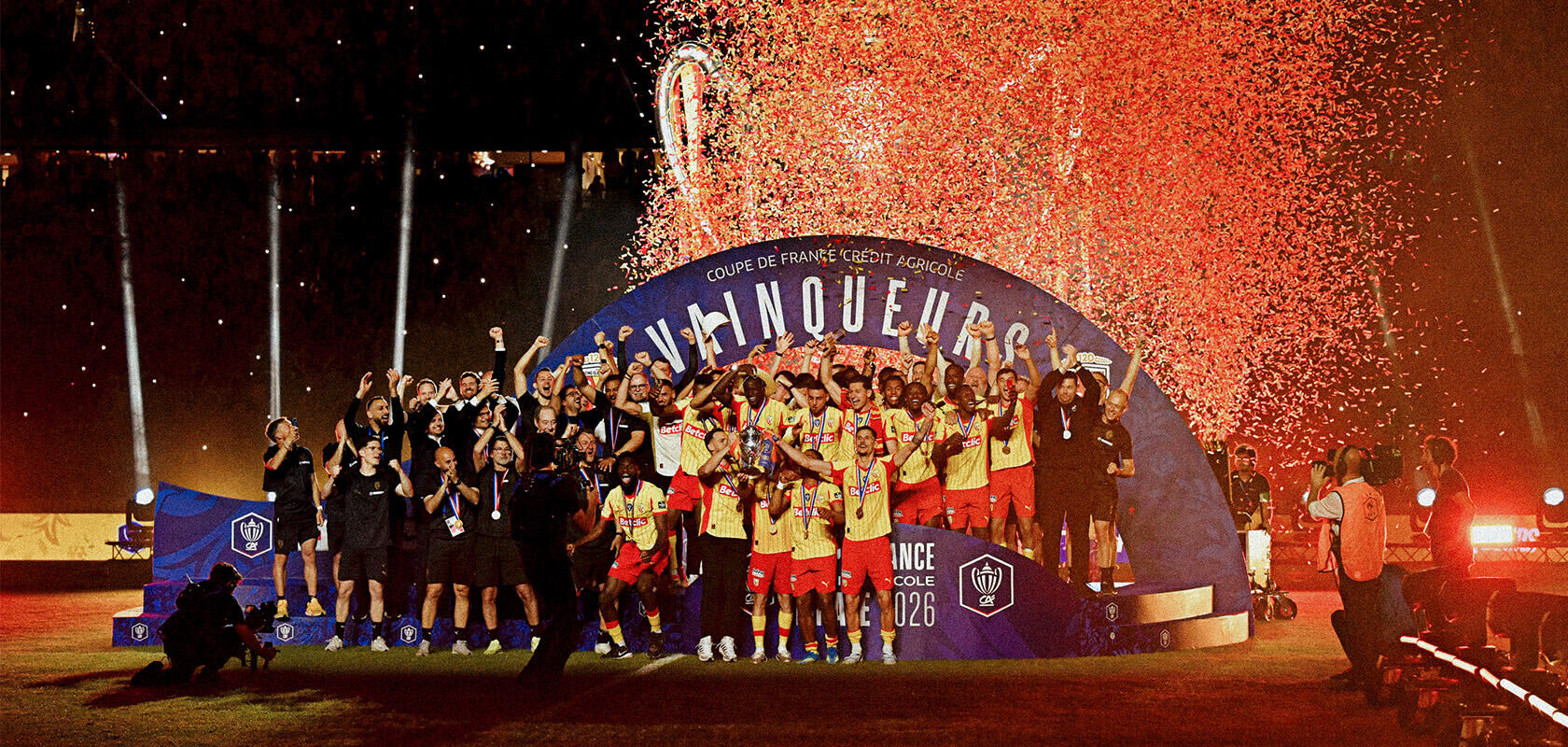
The 2025-26 season produced another major chapter in the club’s history. Under Pierre Sage, Lens challenged near the top of Ligue 1 and eventually finished second, securing another Champions League qualification. The greatest achievement arrived in the Coupe de France. After eliminating opponents including Lyon and Toulouse, Racing defeated Nice 3-1 at the Stade de France. It was the first Coupe de France in the club’s history, ending a succession of final defeats stretching back to 1948.
🏆 Coupe de France winners: 2025-26 Watch Lens win their first Coupe de France
Lens then defeated Paris Saint-Germain at Bollaert-Delelis despite playing for approximately 50 minutes with ten men.

🏆 Trophée des Champions winners: 2026 Watch Lens defeat Paris Saint-Germain in the Trophée des Champions
The stadium built by miners, saved by the municipality and sustained by generations of supporters had once again provided the setting for a major Lens triumph.
Bollaert-Delelis: the heart of RC Lens history
The Stade Bollaert-Delelis remains the physical and emotional centre of the club. Its four steep stands surround the pitch in a structure reminiscent of traditional English grounds, creating an intense atmosphere. The stadium hosted matches at Euro 1984, the 1998 World Cup and Euro 2016. Its capacity exceeds the population of Lens itself, demonstrating the club’s ability to represent a territory extending far beyond the city limits. Following André Delelis’ death in 2012, his name was added to that of Félix Bollaert. The complete name honours two men who played decisive roles in different periods: Bollaert in the construction of the stadium and Delelis in the club’s survival after the crisis of 1970. The singing of Les Corons transforms the ground into a collective space of memory, connecting current supporters with generations of families shaped by the coal industry.
More than a football club
RC Lens began with students playing football on a public square. It welcomed Italian and Polish workers into its early teams, adopted colours inspired by the Spanish history of Artois and constructed its stadium through the labour of unemployed miners. When the coal industry withdrew, Lens lost its professional status. The municipality and figures deeply connected to the territory rebuilt it. Racing later became champion of France, defeated Arsenal at Wembley, reached a UEFA Cup semi-final and developed a modern academy at La Gaillette. Further relegations and financial difficulties followed, but the club continued to rise again. Few teams have experienced so many different lives while preserving such a recognisable identity. The miner’s lamp on the badge, the red-and-gold colours, the construction of Bollaert and the singing of Les Corons preserve the memory of the mining communities of northern France. Each recovery has strengthened the idea that RC Lens belongs to something greater than its owners, directors or players. It belongs to the community that built it, saved it and supported it across generations. This is the institution Como will encounter in the Champions League. Como will not simply face another French team, but a football club whose stadium, supporters and history remain inseparable from the identity of an entire region.
Leave a Reply