
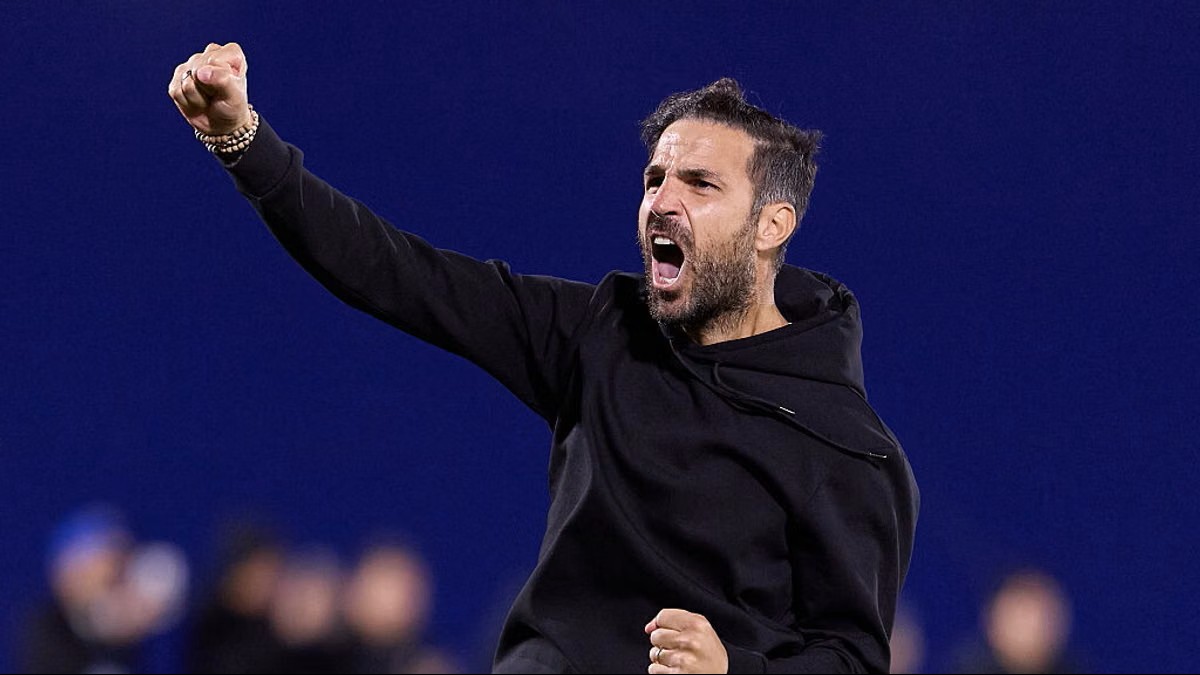
Cesc Fabregas Tactical Laboratory has become one of the most intriguing projects in European football. The Spanish coach has transformed Como into a team built on positional flexibility, tactical innovation and continuous player development.
A year ago, Como were an ambitious club trying to establish themselves among Italy’s elite. Today, they are one of Serie A’s most compelling stories, a team capable of defeating Manchester United in the Champions League, challenging the traditional powers domestically, and earning praise across Europe for their style of play.
At the heart of that transformation stands Cesc Fàbregas.
The former Barcelona, Arsenal and Chelsea midfielder has built far more than a competitive team. He has created a tactical laboratory where players constantly evolve, positions are fluid and flexibility is considered one of the squad’s greatest strengths.

Why the Cesc Fabregas Tactical Laboratory Is Working
The success of the Cesc Fabregas Tactical Laboratory is based on adaptability rather than rigid tactical structures.
No player better represents Como’s evolution than Lucas Da Cunha.
When the Frenchman arrived in January 2023, he was primarily viewed as an attacking winger capable of operating on either flank. Under Fàbregas, however, Da Cunha has undergone a remarkable transformation.
Rather than remaining close to the opposition penalty area, he now frequently operates as a deep-lying playmaker, helping initiate attacks, dictate tempo and connect every phase of Como’s possession game.
Lucas Da Cunha has become one of the most important examples of the Cesc Fabregas Tactical Laboratory in action: what originally appeared to be a temporary solution has become one of the team’s most important tactical advantages.
Against Manchester United in the Champions League, Da Cunha moved seamlessly between midfield and attacking positions, demonstrating the versatility that has made him indispensable to Como’s system.
Freedom Through Structure
One of the most interesting aspects of Fàbregas’ football is that positional freedom actually comes from a highly organized structure.
Players are encouraged to interpret multiple roles during the same match, but every movement is designed to serve a tactical purpose.
When Como build from the back, what appears chaotic to opponents is often a carefully rehearsed mechanism designed to create numerical superiority and exploit space.
This philosophy has allowed the team to absorb injuries that might otherwise derail a season.
The Rise of Nico Paz
While Da Cunha represents adaptability, Nico Paz represents star quality.
The Argentine continues to establish himself as one of Europe’s brightest young talents and enters the Sassuolo match after scoring a stunning brace against Manchester United.
His ability to operate between midfield and attack makes him a perfect fit for Fàbregas’ positional approach.
Whether playing as a traditional attacking midfielder, drifting wide or acting as a false nine, Paz consistently creates problems for defenders who struggle to track his movement.
The midfielder has now scored six goals in his last seven appearances for club and country, emerging as the face of Como’s exciting project.
The Full-Back Revolution
Few teams in Serie A use their full-backs quite like Como.
Rather than remaining on the touchline, Yan Couto and Álex Valle regularly move into central midfield positions during the build-up phase.
This creates additional passing options and allows Como to dominate possession in key areas of the pitch.
The movement simultaneously opens spaces for attacking players such as Martin Baturina and Nico Paz, creating the fluid attacking patterns that have become a hallmark of Fàbregas’ side.
To opponents, Como often seem to have an extra midfielder on the pitch.
Jacobo Ramón and the Disappearing Centre-Back
The tactical experimentation does not stop there.
Young defender Jacobo Ramón has frequently been given freedom to step into midfield or even attacking positions during possession phases.
Against opponents such as Roma and Inter, the former Real Madrid prospect advanced well beyond the defensive line, helping create overloads and stretching opposing structures.
His technical quality allows him to contribute far beyond traditional defensive responsibilities.
It is another example of how Fàbregas views positions as starting points rather than limitations.
When Experiments Fail
Not every idea works perfectly.
During Como’s trip to Feyenoord, Fàbregas experimented with Nico Paz and Martin Baturina as attacking references while preserving Tasos Douvikas.
The move failed to provide sufficient attacking threat and Como looked significantly more dangerous after the Greek striker entered the match.
Yet these setbacks are part of the process.
The willingness to experiment has also produced major successes, including the tactical solutions that helped Como defeat stronger and more experienced opponents.
Why Europe Is Starting to Notice
Como’s progress is no longer attracting attention only in Italy. As the Cesc Fabregas Tactical Laboratory continues to evolve, Europe’s biggest clubs are beginning to take notice.
Reports from Spain suggest that Barcelona are closely monitoring Fàbregas’ development as a coach, impressed by the work he has done both domestically and in Europe.
The interest is understandable.
In a short period, Fàbregas has built a team capable of competing in the Champions League while maintaining one of the most attractive playing styles in Italian football.
Asked recently about speculation regarding his future and whether Alberto Aquilani could someday succeed him, the Spaniard dismissed any suggestion of leaving.
“I have never thought about going away. If I started thinking about it, maybe that would be my end.”
For now, his focus remains entirely on Como.
The Baturina Story
The emergence of Martin Baturina provides another example of the club’s intelligent planning.
Como president Mirwan Suwarso recently revealed that the Croatian was not originally the club’s first-choice target. The club had initially pursued Petar Sučić, but negotiations collapsed due to the size of the agent commissions involved.
That failed move opened the door for Baturina’s arrival.
Today, the Croatian has become one of the key figures in Fàbregas’ tactical setup and another symbol of Como’s rapid growth.
Sometimes the best transfer decisions are the ones clubs never make.
A Curious Champions League Paradox
Perhaps the most surprising statistic surrounding Como’s rise concerns their Italian players.
Despite leading the Champions League standings among Italian clubs after the opening rounds and producing one of the competition’s biggest victories by defeating Manchester United 4-1, Como have received very limited contributions from Italian starters in Europe.
Moise Kean, Samuele Ricci, Alberto Dossena and Mattia Liberali have collectively played only limited minutes, mostly from the bench, while foreign players continue to form the backbone of the team.
It is a curious paradox for a club representing Italian football so successfully on the European stage.
Another Test Against Sassuolo
As Como prepare to face Sassuolo, injuries once again force Fàbregas to think creatively.
Moise Kean, Mattia Liberali and several other players remain unavailable, creating fresh tactical questions for the Spanish coach to solve.
History suggests he will find an answer.
That has become the defining characteristic of this Como team. Whether reinventing Lucas Da Cunha, repositioning full-backs, promoting young talents or reshaping the structure to compensate for injuries, Fàbregas consistently finds new ways to keep his side competitive.
The result is one of the most innovative teams in Europe and a project that shows no signs of slowing down.
Leave a Reply